Aurélie
L'Amour et les ForêtsAurélie is a primary-school teacher whose account at Sainte-Blandine reveals how a brief meeting can be transformed into years of stalking and fear. A man she met at Metz Plage treated her refusal as a temporary obstacle, not a decision; his pursuit came to dominate her nights, her thoughts, and her hopes for the future. Among the clinic’s patients, she finds compassionate listeners, and later signs of laughter and ease suggest a modest, incomplete reprieve.
Identity and Circumstances
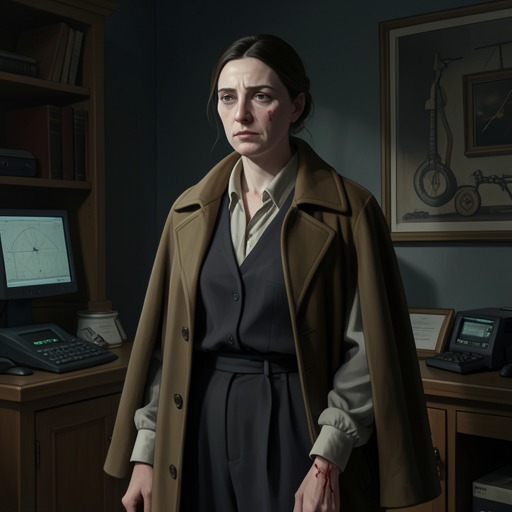
Aurélie had once considered herself joyful, funny, and fond of life. By the time she tells her story at Sainte-Blandine, however, she describes herself as unable to sleep and constantly in tears, and feels that her appearance reflects the strain. She is approaching forty and longs to have children; she fears that the years in which she hoped to meet someone and build a family are being consumed by the harassment. Her distress is not presented as a passing alarm: she says the man has become the fixed subject of her days, even when he is not physically outside her home.
She had enjoyed spending summer evenings alone at Metz Plage, listening to concerts from a deck chair. There she noticed a man looking at her, while she deliberately avoided returning his gaze because she was cautious about encouraging men. After the concert he caught up with her and began a conversation. His careful speech and apparent refinement made their meeting seem ordinary and promising rather than threatening. He gave her his telephone number; she called him several days later, and accepted an invitation to his studio the following Saturday.
From a Brief Encounter to Stalking
At the studio they talked and kissed. When the evening seemed to be moving toward sex, Aurélie said she needed to go home and sleep. He offered to let her stay without touching her, but she did not want to remain. His intense, almost worshipful attention had already unsettled her. Later, when she returned to his studio, she explained that she had come back to be less abrupt and more courteous. He instead treated the visit and the earlier intimacy as proof that she was attracted to him, dismissing her explanation as a misunderstanding and insisting that she would eventually love him.
The pursuit crossed into her private life when he began leaving declarations on her car outside her home, including messages saying that he loved her and that she was the love of his life. Aurélie had not given him her address or surname and was listed under a restricted directory entry. She concluded that he must have followed her from work, whose location she had told him. The messages appeared repeatedly, and she experienced their accumulating presence as a tightening constraint. When she telephoned to tell him plainly that she wanted no relationship and that he should leave her alone, he recast her earlier actions as evidence of a desire she supposedly did not understand. He also told her that the police would not frighten him.
He disclosed that he had previously pursued a young woman in Toulouse for five years, after living with her for a week. According to what he told Aurélie, he had served two prison terms, spent six months in a psychiatric hospital, and been barred from returning to that department. He presented his move to Metz as having led to an even more powerful encounter, and said that Aurélie would ultimately live with him and bear his children. His account made clear that he understood persistence not as a violation of her refusal but as a destined conclusion. The story attributes this history to his own claims, relayed by Aurélie, rather than establishing it independently.
The Cost of Being Pursued
The stalking continued for two years. At night the man circled her home and car, touching the vehicle or leaving visible marks, words, drawings, and sometimes scratches, particularly on the front-left door. He was imprisoned for six months after Aurélie’s stepfather surprised him outside her home and photographed him. The judgment after his release barred him from entering her neighborhood, but his time in prison did not stop the behavior. Aurélie needed new evidence of him violating the order if she was to seek his return to prison, yet she could not afford a private investigator, and the regular police patrols never coincided with his appearances.
She tried to photograph him herself, but he seemed to appear when she was not watching and disappear when she was at the window. One night in February, after a week of signs that he had been outside every night, she invited a friend to keep watch with her. They stayed up at the kitchen window, drinking red wine. When her friend left briefly to look for shampoo, Aurélie turned from the window; on returning, she saw her own name written in the snow on the roof of her car. That episode intensified her fear. The account does not establish how he managed to leave the message unseen; for Aurélie, its appearance made the pursuit feel impossible to anticipate or control.
Her vigilance became exhausting and all-consuming. She repeatedly got up at night with a camera, while daylight and noise made it difficult for her to sleep during the day. She took sick leave but could not recover; when she was due to return to work, she did not feel able. Her doctor recommended rest at Sainte-Blandine. The threat therefore reaches beyond the nights when the man appears: it disrupts sleep, work, and her imagined future, leaving her with the sense that her life has become a continuous, solitary confrontation with him.
Witnesses and a Tentative Return
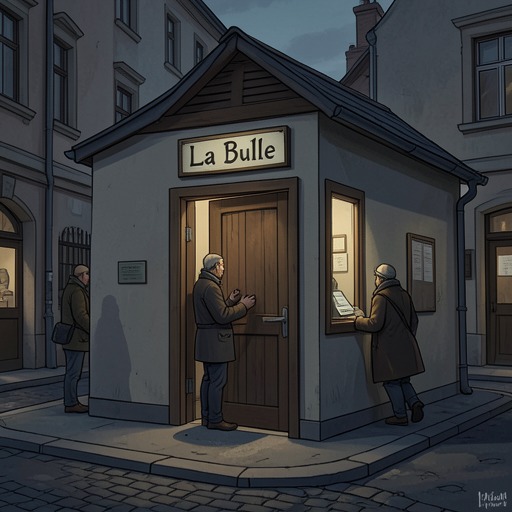
At La Bulle, Aurélie recounts the history to the other patients. Élisa takes her hand and asks how the pursuit began; Bénédicte Ombredanne asks whether the man had been an earlier boyfriend. When Aurélie explains that she met him at Metz Plage and that the contact had been brief, the group listens with visible concern. Her account of the name in the snow, and of the man’s earlier pursuit of another woman, is met not with blame but with shared silence and compassion. Bénédicte feels a strong wish to love and protect her.
Later, the other patients notice a slight change. Aurélie appears more relaxed than she had a few days before, and Élisa’s company makes her laugh aloud, something the group had not seen her do. She joins Élisa at the counter for another waffle. These moments do not establish that the stalking has ended or that Aurélie has recovered; they mark a small easing within the clinic, where companionship briefly competes with the fear that had filled her attention.
Narrative Role
Aurélie’s story distinguishes affection from a claim imposed on another person. The man turns a conversation, a visit, and a kiss into supposed evidence that her refusal is not real, then invokes destiny to justify continuing after she has clearly rejected him. The narrative shows the consequences in practical details—the car watched at night, the unsuccessful search for proof, the camera kept ready, the missed return to work—rather than treating pursuit as romantic persistence.
Her account also becomes an occasion for listening among the patients. Bénédicte’s attention and the group’s compassionate response do not solve the danger, but they interrupt Aurélie’s isolation and recognize the damage it has done. Her later laughter is consequently a limited but meaningful change: not a resolution, but evidence that, in the clinic’s company, the stalker is not the only presence shaping her days.